


Resilience as the New Competitive Edge for the Philippines’ Top 1000 Companies
In recent years, Philippine businesses have learned that disruptions seldom occur alone—they tend to overlap, compound, and escalate. A system outage can coincide with a vendor delay, or a climate event can strike when teams are already stretched thin. For the country’s Top 1000 Companies, this shift has redefined what competitiveness means. Leaders are no longer distinguished by how strong their operations are on a normal day but by how quickly and consistently they can recover when things go wrong.
Across the organizations we work with, one theme keeps emerging: companies are becoming more interconnected and more ambitious, yet their resilience practices do not always scale at the same pace.
Where Market Leaders Are Feeling the Strain
Despite varied circumstances across industries, three pressure points appear repeatedly:
1. Growth comes with hidden fragility.
As organizations expand, processes built for smaller teams begin to strain, decision-making becomes more dispersed, and dependence on digital tools and external providers deepens. A payroll delay, brief systems outage, or vendor delivery issue that once affected a small group can now disrupt entire business lines or regions. Leaders often only see this fragility when an incident forces teams to improvise without a clear playbook. By then, time has already been lost, and the cost of the disruption is higher than it needed to be.
In one engagement with a fast-growing cooperative, for example, the launch of an online member portal was meant to make it easier for members to check balances and transact without visiting branches. But due to a sudden and prolonged period of downtime, members could not view their savings and loan balances online. What seemed like minor system availability issues triggered a surge of complaints and reputational strain on the management. This was not because the cooperative’s processes were unsound but because its new digital channel was not yet designed and governed with the same resilience as its traditional operations.
2. For regulated firms, failure becomes public.
Banks, fintechs, insurance companies, and other regulated entities operate under heightened expectations of continuity. A service interruption is no longer an internal incident; it becomes a test of governance, compliance, and public accountability.
Regulators increasingly ask not only, “Do you have a plan? ” but also, “Can you show that it works?”
3. High-reliability sectors carry the heaviest burden.
Hospitals, utilities, energy providers, and transport operators have extremely low tolerance for downtime. Their services underpin public welfare and economic activity, which means even short delays can ripple outward – affecting patient care, safety, communities, and public confidence. Yet recovery efforts often depend on a handful of experienced individuals or routines developed years ago. When those people are unavailable, the organization risks losing valuable minutes at the very moments it can least afford them.
A Common Pattern Across Philippine Organizations
While industry pressures differ, what happens inside organizations during disruptions follows a familiar pattern. Across our work with Philippine organizations and our recent resilience readiness survey1 across multiple sectors, four internal dynamics consistently surface:
1. Risk awareness is strong, but not always operationalized.
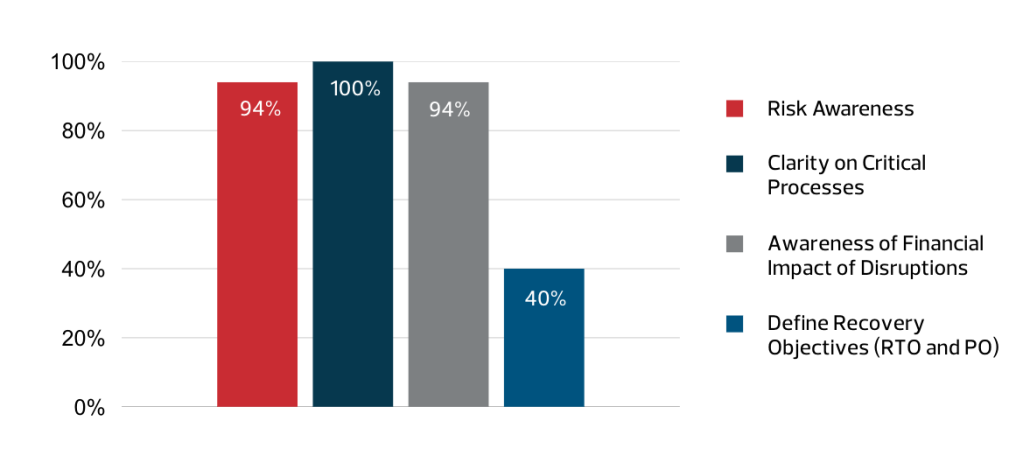
Risk awareness across respondents is notably high. In the survey, 94% of organizations report moderate to high awareness of their top operational risks and external dependencies, while 100% indicate clarity on which processes must resume within 24-48 hours to prevent significant loss. Awareness of the potential financial impact of a one-day disruption is similarly high at 94%.
However, this awareness does not always translate into operational execution. Only 40% of respondents rate their organizations as strong in having defined Recovery Time and Recovery Point Objectives (RTO/RPOs) for major processes. This gap helps explain why, during disruptions, teams often spend valuable time aligning on actions that leadership already understands conceptually but has not yet translated into clear, actionable recovery targets.
2. Foundational controls exist, but operational readiness varies.
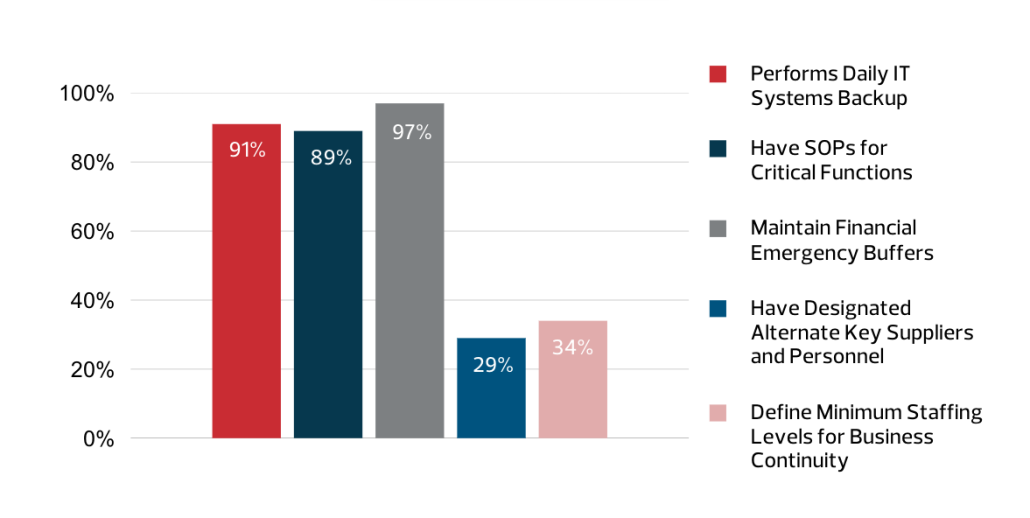
Foundational safeguards are largely in place. 91% of respondents report daily IT system backups, 89% have documented SOPs for critical functions, and 97% maintain a financial buffer for emergencies or business interruptions. These controls suggest a solid baseline of preparedness across many organizations.
Yet readiness drops when measured by practical usability. Only 29% report that alternates for key suppliers or critical roles are fully designated, and just 34% have fully defined minimum staffing levels required for continued operations. This disparity explains why early response capability varies widely, even among organizations that appear well-controlled on paper.
3. Recovery readiness is the softest point.
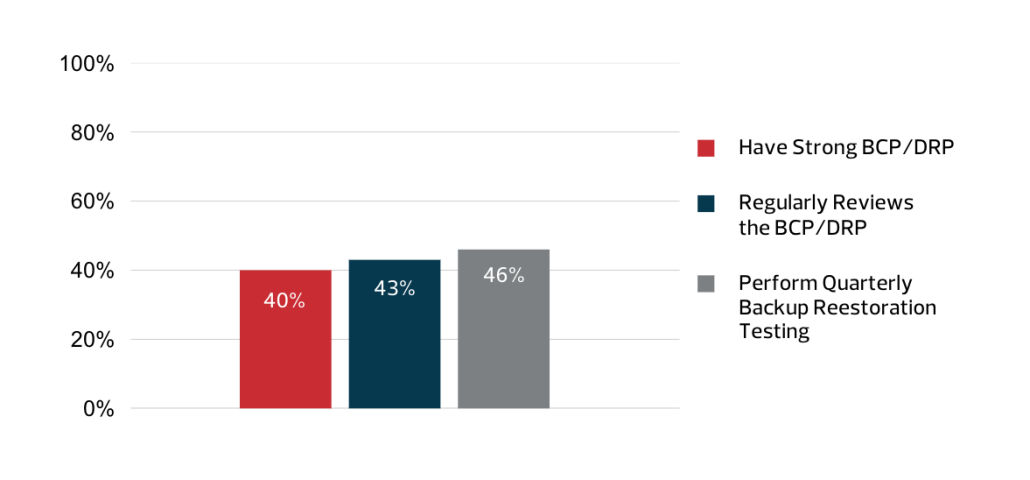
Recovery emerges as the least mature and most inconsistent capability. Only 40% of respondents rate their organizations as strong in having a Business Continuity or Disaster Recovery Plan, conducting tabletop exercises within the past 12 months, or defining RTO/RPOs. Regular review of recovery plans shows a similar result, with 43% rating this as strong.
Operational proof points reinforce this finding: only 46% of organizations report quarterly backup restore testing as fully implemented. As a result, many organizations only discover recovery constraints once a real disruption is already underway, turning manageable incidents into prolonged interruptions.
4. Leadership commitment is present, but follow-through lacks rhythm.
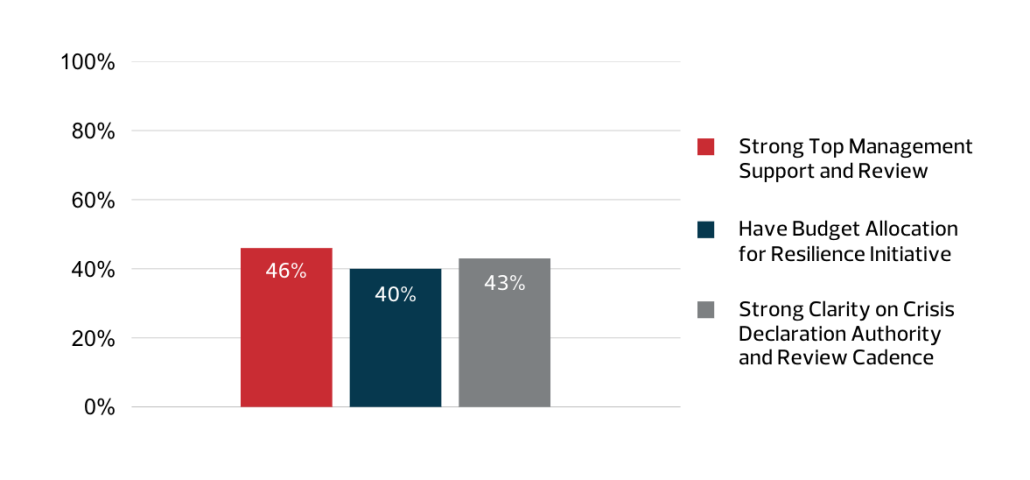
Leadership intent is encouraging but unevenly institutionalized. 46% of respondents rate top-management support and review of resilience planning as strong, reflecting visible executive interest. However, only 40% rate budget allocation for resilience initiatives as strong, and 43% indicate strong clarity around crisis declaration authority and review cadence.
Without a consistent governance rhythm—clear ownership, funding, and regular review—resilience efforts tend to lose momentum once immediate operational pressures ease.
What CEOs Must Prioritize in 2026
The good news is that strengthening resilience does not always require major investment or large new programs. Often, the biggest gains come from clarity, discipline, and practice:
- Create a short, usable recovery playbook that teams can follow under pressure—not a thick manual, but a concise guide that clarifies who declares, who leads, what to restore first, and how to communicate.
- Define succession arrangements and logistics so that key roles have named alternates, and critical equipment, access, and data can be reached even if the primary person or site is unavailable.
- Rehearse outages at the leadership level through tabletop exercises that walk through realistic events from declaration to restoration. This builds muscle memory, highlights gaps, and clarifies decision points before a real incident occurs.
- Test backup restores regularly under controlled conditions to build confidence that, when needed, systems and data can come back online within acceptable timeframes.
These actions are not about perfection. They are about reducing the surprise factor when disruptions happen and enabling teams to move with speed and in alignment with the most important objectives of the organization.
Looking Ahead: Leading Resilience at Enterprise Scale
At RT&Co., we work with leadership teams to shape resilience as an enterprise capability—one strengthened by clear direction, practiced coordination, and the confidence to adapt when conditions shift.
If your organization is shaping its resilience roadmap or preparing for its next stage of growth, we would be glad to support your journey:

Glenn William S. Alcala
Partner, Advisory Services
+63.917.834.9634
gwsalcala@reyestacandong.com

Karen V. Segovia
Senior Manager, Advisory Services
+63.917.107.5825
kvsegovia@reyestacandong.com
Contact us today. We’ll schedule a complimentary assessment of your company.
Let RT&Co help your business. Send your request for a proposal of services here.