


Tax Tweets
Full April 2026 Tax Tweets
A monthly publication of Reyes Tacandong & Co.’s Tax Division
| What’s Inside | |
|---|---|
| BIR ISSUANCES | 8 |
| SEC ISSUANCE | 1 |
| FIRB ISSUANCE | 1 |
Tax Tweets is Reyes Tacandong & Co.’s official monthly publication which highlights select and significant issuances and advisories of various government agencies including the Bureau of Internal Revenue (BIR), Securities and Exchange Commission (SEC), Bureau of Customs (BOC), Fiscal Incentives Review Board (FIRB), Philippine Economic Zone Authority (PEZA), and other regulatory bodies.
This Tax Tweets Issue covers select and significant issuances and advisories from April 2026.
Bureau of Internal Revenue Issuances
REVENUE REGULATIONS
Implementing Executive Order No. 114, Series of 2026 “Temporarily Suspending the Excise Taxes on Specific Petroleum Products Pursuant to Section 148 of Republic Act No. 8424 or the National Internal Revenue Code of 1997, As Amended”
Revenue Regulations No. 3-2026
Date Posted (BIR Website): 17 April 2026
RR No. 3-2026 was issued to implement Executive Order (EO) No. 114, Series of 2026 suspending the imposition of excise taxes beginning April 17, 2026, for the following covered petroleum products:
a. LPG, except when used as raw material for the production of petrochemical products or used for motive power; and
b. Kerosene, except when used as aviation fuel.
The suspension of excise taxes shall apply only to these petroleum products removed from the place of production or customs custody after the effectivity of Executive Order (EO) No. 114, Series of 2026.
The duration of the temporary suspension of excise taxes on the covered petroleum products under Section 2 of RR No. 3-2026 shall be for a period of three (3) months from the effectivity of the EO [or three (3) months from April 17, 2026]. The suspension of excise taxes shall be subject to monthly review by the Development Budget Coordination Committee (DBCC) which shall recommend to the President the continuation, modification, extension or termination thereof.
Reversion to the previously imposable excise tax rates under Section 148 of the National Internal Revenue Code (hereinafter referred to as the Tax Code, as amended) on the covered petroleum products shall be automatic without the need for further issuances, upon the occurrence of any of the following:
a. One (1) week after the one (1)-month average Dubai crude oil price based on MOPS falls below USD 80 per barrel, as certified by the Department of Energy (DOE); or
b. Upon expiration of the three months as mentioned in Section 2 of RR No. 3-2026.
Pursuant to Section 5 of RR No. 3-2026 there are reportorial requirements that must be complied with as follows:
a. Submission of Returns and Reports:
i. Manufacturers of domestically-produced LPG and kerosene shall:
1. Continue to submit the corresponding tax returns with the BIR indicating the corresponding tax rate as “zero” with remarks “EO NO. 114, SERIES OF 2026”. All other pertinent fields shall be filled out in the regular course of business; and
2. Submit the corresponding Official Register Books (ORBs) per removal of LPG and kerosene products.
ii. Importers of LPG and kerosene products shall:
1. Continue to submit the corresponding tax returns to the BOC; and
2. Secure the corresponding Authority to Release Imported Goods (ATRIG) with remarks “EO NO. 114, SERIES OF 2026”.
b. Stock Inventories. Concerned manufacturers, importers, and lessees of storage depots shall submit duly notarized inventories of all covered petroleum products as of April 16, 2026 to Excise LT Field Operations Division (ELTFOD) in the case of taxpayers registered within Revenue Region (RR) Nos. 4 (Central Luzon), 5 (CaMaNaVa and Bulacan), 6 (City of Manila and Palawan), 7A (Quezon City), 7B (East NCR), 8A (Makati City), 8B (South NCR), 9A (CaBaMiRo) and 9B (LaQueMar) or to the concerned Excise Tax Area (EXTA) in the case of taxpayers registered outside of RR Nos. 4 to 9B, within ten (10) days after the effectivity of the EO, in the prescribed format in Annex “A” of RR No. 3-2026. These sworn statements shall likewise be subjected to verification as required under existing regulations and issuances.
c. Issuance of Withdrawal Certificates. All Withdrawal Certificates issued for the removal of covered petroleum products covered by the suspension shall be prominently stamped with the phrase “STOCKS COVERED BY EO No. 114, SERIES OF 2026”.
While RR No. 3-2026 implements the suspension of excise taxes for the covered products as enumerated therein, taxpayers are advised to take note of the duration of the exemption from excise taxes as well as to comply with the reportorial requirements as enumerated in Section 5 thereof to ensure that the utilization of the exemption on excise taxes is fully compliant with RR No. 3-2026 and is duly supported by the relevant documents.
REVENUE MEMORANDUM CIRCULARS
Extension of the deadline for the Filing of 2025 Annual Income Tax Returns and Payment of the Corresponding Taxes Due Thereon Including Submission of Required Attachments
Revenue Memorandum Circular No. 30-2026
Date Posted (BIR Website): 14 April 2026
RMC No. 30-2026 was issued by the BIR to extend the deadline for the filing of the 2025 Annual Income Tax Returns, pay the corresponding taxes due thereon, and submit the required attachments without the imposition of penalties, particularly at a time when the effects of rising oil prices are being felt from 15 April 2026 to 15 May 2026.
Note:
For purposes of brevity, please note that the BIR subsequently issued RMC No. 39-2026 providing for further clarification on the deadline for the submission of required attachments to the 2025 Annual Income Tax Returns. Under said issuance where multiple scenarios were provided, it was clarified that submission of required attachments is extended also up to 15 May 2026 only.
Circularizing Joint Administrative Order No. 001-2025 entitled “GUIDELINES ON THE TREATMENT OF DONATIONS TO THE NATIONAL DAIRY AUTHORITY (NDA)”
Revenue Memorandum Circular No. 32-2026
Date Posted (BIR Website): 20 April 2026
The Joint Administrative Order (JAO) issued by the BIR and the Department of Agriculture – National Dairy Authority (NDA) prescribes the process and guidelines for availing the tax exemption on donations made to the NDA. Section 18 of the Implementing Rules and Regulations (IRR) of Republic Act (RA) No. 7884 provides for exemptions for certain donations, specifically stating:
“SEC. 18. Exemptions from Taxes and Duties. – xxx
(1) xxx
(2) xxx
(3) xxx
(4) xxx
Any donation, contribution, bequest, subsidy or financial aid which may be made to the Authority shall constitute as allowable deduction from the income of the donor for income tax purposes and shall be exempt from donor’s tax, subject to such conditions as provided under the National Internal Revenue Code, as amended.” [Underscoring supplied] Under Section 4 of JAO 001-2025, the following are the accredited programs of the NDA which may be the subject of donation from donors (as defined in the JAO):
a. Milk Feeding Program; and
b. Enterprise Assistance Through Equipment and Technology Support
The JAO expressly mentions that the NDA is authorized to receive donations, grants, and contributions from the private sectors for the development of the local dairy industry through its programs. The BIR on the other hand determines the propriety of donations, grants, or gifts to the NDA. In this regard, taxpayers/donors who shall donate to the NDA should observe the following compliance requirements to ensure the deductibility of their donations with the NDA.
i. A certificate from the Department of Economy, Planning, and Development (DEPDev) shall be required for the donors to avail of the full deductibility of the donation, in accordance with Section 34(H)(2)(a) of the Tax Code.
ii. To avail of the tax incentives, donors must submit to the concerned BIR office where the donor is registered, copies of the following:
a. The Deed of Donation executed between the donor and the NDA;
b. Accomplished BIR Form No. 2332 (Certificate of Donation)
c. The Certification from DEPDev that the NDA program is in the [National Priority Plan]
d. This Order [JAO 001-2025] The submission of any false or falsified document shall be a ground for the denial of the tax incentive claim, without prejudice to any criminal, civil, or administrative liabilities under applicable laws, rules, and regulations.
Provides clarification on the filing and payment of Estate Tax under the Estate Tax Amnesty
Revenue Memorandum Circular No. 33-2026
Date Posted (BIR Website): 27 April 2026
RMC No. 33-2026 provides for clarifications on the filing and payment estate tax under the estate tax amnesty:
Q1. When is the deadline for the submission of proof of estate settlement (e.g. Extra Judicial Settlement, copy of Court Order) for those who availed the estate tax amnesty.
A1. There is no deadline to submit the proof of settlement of estate. Non-submission of such proof on or before the June 16, 2025 deadline for availing the Estate Tax Amnesty does not invalidate the application. However, it is important to note that the proof of settlement is required for the processing and issuance of the eCAR, which is necessary for the transfer of the estate’s assets.
Q2. What is the basis in computing the estate tax due for property/ies not declared/included in the previously filed estate tax amnesty return?
A2. The laws and regulations applicable at the time of death of the decedent shall be followed. The applicable tax rate shall be applied to compute the estate tax due only for the undeclared property/ies of the estate.
Q3. Is installment payment allowed in the availment of estate amnesty?
A3. Yes, installment payment may be allowed within two (2) years from the statutory date of its payment without civil penalty and interest, subject to prior approval of the concerned RDO. The number of Acceptance Payment Form (BIR Form No. 0621-EA) to be issued shall be equal to the number of installment payments applied for and approved. Provided that the 1st installment was paid on or before June 16, 2025. Installments need not be of equal amounts, provided that the total amount of installment due within the two (2) year period is equal to the total Estate Tax Amnesty due.
Failure to pay any installment on or before its scheduled due date shall be considered a forfeiture of the estate tax amnesty availment. Consequently, the properties covered by the application but not fully settled under the Estate Tax Amnesty shall be subject to the applicable estate tax laws in effect at the time of the decedent’s death. The estate tax due shall be computed based on the applicable tax rates, deducting any payments already made under the amnesty and shall include the corresponding delinquency penalties.
Clarifying the Deadline of Filing of Request for Reconsideration of the Full or Partial Denial of the Claim for VAT/Excise Tax Refund Within the National Office Pursuant to Revenue Regulations No. 8-2025 and Request for Reconsideration of the Final Decision on Disputed Assessment Pursuant to Revenue Regulations No. 12-99, as Amended, in Light of Memorandum Circular No. 114 Dated March 6, 2026
Revenue Memorandum Circular No. 35-2026
Date Posted (BIR Website): 27 April 2026
Memorandum Circular No. 114 dated 6 March 2026 of the Office of the President directed all government agencies and instrumentalities to strictly adopt energy conservation protocols. Revenue Memorandum Order (RMO) No. 7-2026 was issued providing the guidelines for the implementation thereof. Relative thereto, RMC No. 35-2026 was issued to clarify the deadline of filing of Request for Reconsideration of the Partial or Full Denial of Claims for VAT/Excise Tax Refund with the BIR National Office pursuant to RR No. 8-2025 and Request for Reconsideration of the Final Decision on Disputed Assessment (FDDA) pursuant to RR No. 12-99.
Under RMC No. 35-2026, the BIR clarified that for Request for Reconsideration of the Partial or Full Denial of Claim for VAT/Excise Tax Refund within the National Office or Request for Reconsideration of the FDDA, with due date falling on a Friday, the deadline of filing thereof shall be moved to the next business day, when personnel from the National Office are working on-site.
Taxpayers should likewise take note of the following:
1. RMC No. 35-2026 does not affect the requirements and procedure of filing of a Request for Reconsideration of the Partial or Full Denial of Claim for VAT/Excise Tax Refund or Request for Reconsideration of the FDDA provided under RR No. 8-2025 and RR No. 12-99, as amended, respectively.
2. RMC No. 35-2026 takes effect immediately and shall remain in force during the effectivity of RMO No. 7-2026. Under RMO No. 7-2026, the adoption of the Four (4)-day Work Week Arrangement (FWWA) shall remain in effect until lifted or sooner revoked by the President. This arrangement shall serve as an interim measure, to be continued only until circumstances warrant its modification or discontinuance.
Availability of Offline Electronic Bureau of Internal Revenue Forms (eBIRForms) Package Version 7.9.6.0
Revenue Memorandum Circular No. 36-2026
Date Posted (BIR Website): 28 April 2026
Taxpayers are reminded to install the updated/latest version of the Offline eBIRForms Package v7.9.6.0 which contains the following enhancements:
1. Inclusion of BIR Form No. 1701-MS August 2024 [Annual Income Tax Return for Individuals Classified as MICRO or SMALL Taxpayers], which shall be filed on or before the 15th day of April of each year covering income of the preceding taxable year. Pursuant to Revenue Memorandum Circular (RMC) No. 30-2026, the deadline for the filing of 2025 Annual Income Tax Return (AITR) is extended to May 15, 2026. Taxpayers are advised to download and install the latest version that includes improved security on efiling submission.
2. New Alphanumeric Tax Codes (ATCs) have been added in BIR Form No. 1601-EQ, to wit:
| BIR Form No. | Particulars | Tax Rate | ATC (Individual) | ATC (Corporate) |
|---|---|---|---|---|
| 1601-EQ | Income payments made by top withholding agents, either private corporations or individuals, to the manufacturers and direct importers of motor vehicles in Completely Built Units (CBUs) or Semi-Knockdown (SKD) units, motor vehicle parts and accessories. | ½% | WI840 | WC840 |
| Income payments made by top withholding agents, either private corporations or individuals, to the manufacturers and direct importers of medicine/pharmaceutical products. | ½% | WI850 | WC850 | |
| Income payments made by top withholding agents, either private corporations or individuals, to the manufacturers and direct importers of solid or liquid fuels and related products. | ½% | WI860 | WC860 |
3. Increase in character field length of Taxpayer Identification Number (TIN) Branch Code, from three (3) digits to five (5) digits branch code in all tax returns.
4. Updated tax rates, from 15% to 20%, in Schedule 1 for Foreign Currency Deposit based on the return period being filed in BIR Form No. 1602Qv2018.
5. Bug fixes for the following BIR Forms: 0619E, 1601FQ, 1604F, 1702Qv2018C, 1702EXv2018, 1702MXv2018C, 1707v2021, 2000-OT and 2551Qv2018.
Amending Pertinent Provisions of Revenue Memorandum Circular No. 20-2026 to Include Electronic Filing of BIR Form No. 1701-MS Through the BIR Offline eBIRForms Package 7.9.6
Revenue Memorandum Circular No. 37-2026
Date Posted (BIR Website): 28 April 2026
RMC No. 37-2026 amended RMC No. 20-2026 dated 16 March 2026 in view of the availability of BIR Form No. 1701-MS (Annual Income Tax Return for Individuals Classified as Micro and Small Taxpayers) in the Offline eBIRForms Package 7.9.6:
IV. GUIDELINES IN THE FILING OF BIR FORM NOS. 1701-MS, 1701 AND 1701A
In response to the inquiries raised by micro and small taxpayers regarding the filing of their AITRs, the following guidelines are hereby issued to clarify the applicable procedures and provide guidance in the filing of BIR Form Nos. 1701-MS, 1701, and 1701A. x
| No. | BIR Form No. | Manner of Filing | Manner of Payment |
|---|---|---|---|
| 1 | 1701-MS | Manual
Electronic
|
Online Payment
|
| 2 | 1701A | Electronic via Offline eBIRForms Package v7.9.5 or eFPS | Online Payment
|
| 3 | 1701 | Electronic via Offline eBIRForms Package v7.9.5 or eFPS | Online Payment
|
Prescribing the Issuance and Posting of the BIR Registration Seal Badge on Online Websites, E-Commerce or E-Marketplace Seller/Merchant’s Page and Other Platforms, and Announcing the Availability of QR Code in the BIR Certificate of Registration
Revenue Memorandum Circular No. 37-2026
Date Posted (BIR Website): 28 April 2026
RMC No. 37-2026 is issued to implement the requirement under Section 5(H) of RR No. 7-2024 and Section 7 of RR No. 15-2025 on the posting of proof of registration [Certificate of Registration (COR) / Electronic Certificate of Registration (eCOR)] on online websites, e-commerce or e-marketplace seller/merchant’s page, and other platforms.
This requirement applies not only to online sellers of goods but also to persons engaged in providing services through digital or electronic means or with online presence, including but not limited to professionals or persons offering their services through online website, e-commerce platforms or mobile applications, bloggers, vloggers, live streamers, content creators, influencers, and individuals earning through online views, advertisements, affiliate commissions, brand sponsorships, or similar monetized digital activities.
The following are the policies and guidelines under RMC No. 38-2026:
1. The BIR Registration Seal Badge shall be displayed on the seller’s/content creator’s/online influencer’s website, online page/platform, e-commerce shop, in lieu of the BIR COR/eCOR. This is for purposes of addressing taxpayers’ concerns over the online disclosure of sensitive information contained in their COR/eCOR.
Sample BIR Registration Seal Badge:
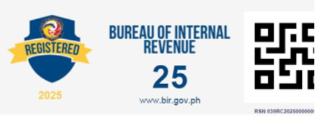
2. The BIR Registration Seal Badge shall be issued [manually or electronically via the Online Registration and Update System (ORUS)] free of charge to all business taxpayers.
3. Both the BIR COR/eCOR and BIR Registration Seal Badge shall contain a Quick Response (QR) Code that can be verified online by scanning the QR Code using any mobile application or QR Code scanner. The QR Code will enable verification of the authenticity of the BIR COR/eCOR and validity of taxpayer’s business registration with the BIR.
4. Taxpayers are not required to replace their existing BIR COR/eCOR that does not contain a QR Code; however, they are encouraged to update or replace the same for the purposes of securing a BIR Registration Seal Badge. Taxpayers who are required to post online a proof of their BIR registration shall secure a BIR Registration Seal Badge with the BIR RDO where they are registered by updating their registration information, or secure it online via ORUS by updating their registration information and paying the P30.00 Documentary Stamp Tax (DST).
5. The BIR Registration Seal Badge shall be posted on the following, including but not limited to:
| Online Business / Transactions / Sales / Services | Where to be Posted |
|---|---|
| 1. Taxpayer’s Website or Own Mobile Application | Any page or link in the website, such as:
|
| 2. E-commerce Platforms and Mobile Applications (Apps) | At the mobile app Support Page, About Page, App Settings, or under links such as:
|
| 3. Sellers, Merchants, or Service Providers with Accounts or Doing Business on E-commerce Platforms, Mobile Applications, or Websites | Seller’s or Merchant’s:
|
6. To ensure consistent and proper online display of the BIR Registration Seal Badge on websites, mobile applications, online shops and e-commerce platforms, the following guidelines shall apply:
· Only the BIR Registration Seal Badge shall be posted on the taxpayer’s official website, mobile application, online shop, or e-commerce platform profile page.
· Taxpayers are not required to upload their entire registration document or the full page where the badge appears. Taxpayers may crop, scan, or extract only the BIR Registration Seal Badge image for the purpose of uploading or posting it to their official website, mobile application, online shop, or e-commerce platform profile page.
· The uploaded BIR Registration Seal Badge should remain clear, readable, and unaltered, preserving all design elements.
· The posting of the BIR Registration Seal Badge must be compliant with the requirement under Item 5 above, ensuring that it is visible and easily accessible to customers as required under Section 5(H) of RR No. 7-2024 and Section 7 of RR No. 15-2024.
Government agencies, banks and financial institutions, e-commerce platforms and other relying parties may verify the validity of the BIR COR/eCOR/BIR Registration Seal Badge and taxpayer’s current registration with the BIR by scanning the QR Code on the document. When the QR Code is scanned, relying parties must ensure that the URL displayed is the official BIR verification domain or BIR link (https://verify.bir.gov.ph/correspondence/) before relying on the result of verification of validity of the BIR COR/eCOR/BIR Registration Seal Badge.
Note:
For further guidance on the part of the taxpayers on how to generate and secure the BIR Registration Seal Badge through ORUS, kindly read through the step-by-step guide under Annex C of RMC No. 38-2026 here: RMC 38-2026 ANNEX C – Taxpayer Guide on how to generate Registration Seal Badge in ORUS.pdf
Securities and Exchange Commission Issuances
Rules on Umbrella Funds
SEC Memorandum Circular No. 14 Series of 2026
Date Posted (SEC Website): 8 April 2026
The SEC issued SEC Memorandum Circular No. 14 Series of 2026 (SEC MC No. 14 s. 2016) by reason of its recognition of the need to expand the structuring options of investment companies to allow the creation, within a single investment company, of Sub-funds that may pursue different investment objectives, policies and strategies, and provide:
i) Investment companies and their fund managers greater operational flexibility and administrative efficiency; and
ii) Investors with opportunities for enhanced and cost-efficient portfolio diversification.
The Rules on Umbrella Funds shall apply to a newly formed or existing open-end unit-issuing investment company which consists of, or is to consist of, two (2) or more Sub-funds with segregated assets and liabilities.
An Umbrella Fund under SEC MC No. 14 s. 2016 is defined as follows:
“f. Umbrella Fund means a registered open-end investment company whose [Articles of Incorporation] and Prospectus provide that it consists of, or is to consist of, two (2) or more Sub-funds where each Sub-fund may pursue similar and/or different investment objectives, policies, strategies, terms, currency, minimum investment amount, fees/charges, among others” [Underscoring supplied]
Among the salient provisions of SEC MC No. 14 s. 2016 pertain to the following:
1. A unit issuing, open-end investment company adopting an Umbrella Fund structure shall include the words Unitized Umbrella Fund in its name.
2. Section 4 of SEC MC No. 14 s. 2016 provides for specific information that must be included in the AOI of an Umbrella Fund.
3. Among the key features introduced under the framework of a unitized Umbrella Fund is the segregated assets and liabilities between Sub-funds. In general, assets of a Sub-fund shall belong exclusively to the same Sub-fund and shall not be used to discharge directly or indirectly the liabilities of, or claim against, any other person or body, including the Umbrella Fund or any other Sub-fund, except as may be provided in SEC MC No. 14 s. 2016.
4. The subscribed and paid-up capital of the Umbrella Fund shall in no case be less than One Hundred Million pesos (Php100,000,000.00)
5. The By-Laws of the Unitized Umbrella Fund shall likewise include specific powers such as the power of the Board of Directors to create new Sub-funds with allocated units not exceeding the total number of units approved by the SEC as well as the power of the Board of Directors to re-allocate the units within an Umbrella Fund subject to certain conditions.
6. An Umbrella Fund must consist of at least two (2) Sub-funds subject to certain conditions and/or accommodations under Section 6 of SEC MC No. 14 s. 2016 such as registration of at least one more Sub-fund within one (1) year from the approval of the first Sub-fund if at the time of the application for a secondary license, the Umbrella Fund is only able to register only one (1) Sub-fund.
7. A Sub-fund has no legal personality separate and distinct from the Umbrella Fund. This notwithstanding, a Sub-fund will be treated as if it were a separate investment company in cases provided under SEC MC No. 14 s. 2016.
8. Termination of a Sub-fund requires SEC authorization. This shall also require prior approval of the majority of the Board of Directors and at least a majority of the outstanding capital stock held by stockholders of the Umbrella Fund.
9. Prior to offering securities, an Umbrella Fund must first secure a secondary license from the SEC and register each Sub-fund separately.
10. The Umbrella Fund shall have its own financial statements. Further, the Umbrella Fund shall be required to prepare separate quarterly and annual financial statements for each Sub-fund, showing clear segregation of assets, liabilities, income, and expenses.
Nevertheless, the Umbrella Fund has the option to prepare a consolidated financial statement. In such consolidated financial statement, the segregated presentation of each Sub-fund’s assets, liabilities, income, and expenses should also be clearly and adequately disclosed in the notes to the financial statements.
For purposes of auditing such financial statements, a single Auditor’s Report may be issued by an independent auditor. The opinion issued must cover the financial statements of the Umbrella Fund and all the existing Sub-funds.
Fiscal Incentives Review Board Issuances
FIRB Resolution No. 005-26
Issued on: 8 April 2026
Pursuant to FIRB Resolution No. 005-26 dated 8 April 2026, as a temporary measure under Rule 24 of RA No. 12066 IRR and in response to the declared national energy emergency under EO No. 110, s. 2026, an RBE registered with an IPA administering an ecozone or freeport shall be allowed to implement WFH arrangements without adversely affecting the enjoyment of its fiscal and non-fiscal incentives.
The following are the general guidelines provided for by the FIRB:
a. WFH arrangements that may be adopted by an RBE shall be up to ninety percent (90%) of their total workforce. For this purpose, “total workforce” shall refer to employees engaged in the registered project or activity of an RBE;
b. The concerned IPA may, at its discretion and based on the specific circumstances, nature of operations, and the needs of the RBEs under its jurisdiction, impose a lower threshold not less than fifty percent (50%) of their total workforce;
c. In the event that the RBE exceeds the threshold imposed by the concerned IPA, the RBE shall pay, as penalty, regular income tax multiplied by the excess of such threshold as imposed by the concerned IPA; Provided, that the excess shall be computed by averaging all excesses made by the RBE in the month of non-compliance;
d. RBEs that will implement the WFH arrangements pursuant to this Resolution shall notify their concerned IPA. Further, the RBE shall submit to their IPA the following, if applicable:
i. (1) verified inventory of laptops, desktops, and other assets, indicating the quantity of each item and distinguishing whether the same are locally procured or imported; and (2) a copy of the surety bond as provided in Item e, if any, in addition to the IPA-prescribed documents and/or reports; and
ii. Within five (5) calendar days after the end of each month, a report of any additional equipment and other assets brought out of the economic or freeport zones, and the details thereof, as mentioned in the preceding item.
The concerned IPA shall diligently monitor the compliance of each RBE implementing WFH arrangements with their performance commitments. All RBEs that avail of this temporary measure shall continue to comply with the reportorial requirements and site inspections, as may be required by their concerned IPA. Non-compliant RBEs shall be meted with the appropriate penalties;
e. Movement of tax- and duty-free imported assets outside the economic and freeport zones shall be allowed subject to the prior approval of the concerned IPA and compliance with existing laws, rules, and regulations, as well as the posting of a surety bond with the Bureau of Customs (BOC); Provided, That only surety companies granted Authority to Transact Business as Surety Company (ATBAS) by the BOC shall be allowed to issue the surety bond; Provided, further, That the surety bond shall be equivalent to one hundred fifty percent (150%) of the applicable taxes and duties, based on the net book value of the assets brought outside the zone, in accordance with pertinent rules. aScITE
The surety bond shall serve as a safeguard to protect government revenues and ensure that such assets are properly accounted for, remain within the customs territory, and are not disposed of, liquidated, or otherwise used in violation of applicable laws, rules, and regulations, including upon the termination of the temporary measures;
f. An RBE may terminate its WFH arrangements prior to the expiration or termination of the declaration of national emergency; Provided, That the RBE shall notify the concerned IPA in writing within seven (7) calendar days prior to the intended date of termination and ensure that all bonded assets and equipment brought outside of the facility have been returned.
Upon return of the equipment and other assets to the economic zone or freeport at any time but not later than the next working day after the termination of the WFH arrangement, the RBE must submit to the BOC a request for the liquidation and cancellation of the bond. Failure to completely return the assets and equipment shall cause the forfeiture of the surety bond as provided under the rules and regulations of the BOC;
g. Movement of locally purchased assets and equipment covered by a value-added tax (VAT) zero-rating may be done upon showing the IPA-issued VAT certificate identifying such assets;
h. In implementing the WFH arrangement, the concerned IPA may adopt additional measures to ensure compliance with the conditions imposed on RBEs. If any, the concerned IPA must notify the FIRB of the additional measures for monitoring and evaluation purposes;
i. Revenues from exports as required shall be maintained regardless of the allowed ratio of employees who will work from home; Provided, That the current number of employees shall not be reduced regardless of whether the majority of their employees are working from home; and (sic)
Note:
The temporary measure is effective from 24 March 2026 and shall remain in force and effect for one (1) year, unless EO No. 110 s. 2026 is otherwise extended or lifted by the President.
Contact us today. We’ll schedule a complimentary assessment of your company.
Let RT&Co help your business. Send your request for a proposal of services here.