


China’s Masterclass in Resilience Planning
Resilience planning is less about preparing for what might happen – and more about discovering what is already fragile.
If resilience were a sport, most of us would still be stretching while China was already halfway through the marathon. And let’s be honest – resilience isn’t glamorous. Nobody brags at dinner parties about their “strategic petroleum reserves.” Yet, when the world’s oil arteries tighten, resilience suddenly becomes the difference between sipping tea calmly and scrambling for candles.
Resilience planning is also counterintuitive. Preparing for extreme scenarios feels wasteful – an expensive exercise for events that may never occur. Yet the real value of resilience planning lies elsewhere. In the process, organizations uncover something far more immediate: single points of failure, hidden interdependencies, and control chain vulnerabilities that lurk today, quietly shaping risk and performance.
The current oil shock – sparked by escalating tensions around the Strait of Hormuz – reminds us that not all crises are surprises. This isn’t a Black Swan, as Nassim Nicholas Taleb would define it. Instead, it is a “gray rhino”: a highly probable, high-impact risk that everyone sees lumbering toward them but often ignores until it charges.
The real story lies not in the disruption itself, but in how nations prepare – or fail to prepare – for it. And here, China offers a masterclass in resilience planning.
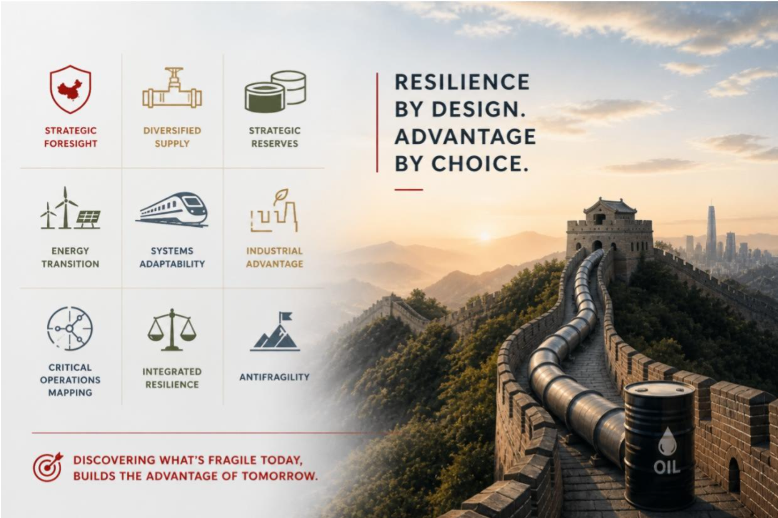
From Known Risk to Strategic Design
China has long treated energy security as synonymous with national security. Vulnerabilities in maritime oil routes – particularly chokepoints like Hormuz and the Malacca Strait – have been openly acknowledged in Chinese policy circles for decades. Rather than dismissing these risks as remote, China embedded them into its long-term strategic design.
This reflects a fundamental principle of resilience:
| Optimize for survivability, not probability.
Instead of asking, “Will a Gulf disruption happen?” China asked, “When it does, can we sustain our economy and strategic posture?”
Building Robustness: Reducing Immediate Fragility
China’s first layer of resilience was robustness – ensuring it could withstand shocks without collapsing. It diversified supply sources through pipelines from Russia and Central Asia, developed overland routes via Pakistan, and built massive underground petroleum reserves along its eastern seaboard.
Today, its reliance on the Strait of Hormuz has been materially reduced. While still significant in absolute terms, exposure is far less concentrated when viewed across diversified supply, overland routes, and strategic reserves – bringing effective dependence down to a small fraction of total energy consumption.
At its core, this reflects a disciplined way of thinking: identifying what must not fail, understanding what it depends on, and systematically reducing points of fragility.
By contrast, the Philippines remains heavily dependent on imported fuel, with limited reserves and grid constraints that amplify exposure to price shocks. Australia, despite its resource base, faces its own challenges – policy volatility, supply chain vulnerabilities, and reserve shortfalls.
These examples underscore a simple point: resilience gaps are rarely the result of missing components. More often, they arise from unseen concentrations of risk – dependencies that are not fully mapped, understood, or managed as a system.
Building Adaptability: Shifting the Energy System
Robustness alone is defensive. China went further, investing heavily in renewable energy, electrified transport, and advanced grid infrastructure.
This reflects a second principle of resilience:
| Adaptability to structural change.
Rather than preserving an oil-dependent model, China has actively reshaped its energy system. This reduces not only geopolitical exposure, but also long-term economic and environmental risks.
Elsewhere, progress has been uneven. In the Philippines, renewable projects often stall due to red tape and grid limitations. In Australia, policy oscillation between coal dependence and renewable expansion has slowed momentum. These cases illustrate that adaptability requires more than investment – it requires consistency of strategic intent.
Building Antifragility: Turning Shocks into Advantage
Perhaps most striking is China’s embrace of antifragility – the ability to benefit from disruption.
Periods of oil market volatility allow China to deploy reserves opportunistically, strengthen domestic industries such as electric vehicles and renewables, and capitalize on the cost pressures faced by more exposed competitors.
This reflects a third principle:
| Do not just endure shocks – leverage them.
Antifragility is the highest expression of resilience because it transforms volatility from a threat into a catalyst – turning every disruption into an accelerator of strategic advantage rather than a setback to be endured.
The Integrated View: Resilience as Strategy
What distinguishes China’s approach is not any single initiative, but its integration across time horizons:
- Robustness in the Short-term: buffers, diversification, redundancy
- Adaptability in the Medium-term: system redesign, energy transition
- Foresight in the Long-term: reduced structural dependence
- Antifragility for Strategic Upside: positioning to benefit from volatility
In many organizations, these elements already exist – but often in isolation. Risk frameworks, compliance programs, and operational safeguards evolve in parallel, consuming resources without delivering a coherent view of how the organization actually holds together under stress.
The issue, therefore, is not the absence of capability – but the absence of integration.
Implications for Boards and Institutions
Boards cannot replicate China’s scale, but they can adopt its logic.
Known risks must be treated as design inputs. Dependencies must be understood explicitly. Structural shifts must be anticipated, and optionality must be built deliberately.
What is often missing is a way to bring these elements together into a single, decision-ready view. Governance, risk, and compliance functions may be well-developed, but when they operate in silos, they dilute leadership attention rather than sharpen it.
The imperative is integration – not for its own sake, but to protect leadership bandwidth and focus it on what truly matters: the continuity and evolution of critical operations.
Approaches that begin with identifying what must not fail – and then mapping how those operations depend on people, systems, data, and third parties (critical operations mapping) – are increasingly gaining traction. Not as additional layers of analysis, but as a way of organizing existing capabilities into a coherent picture that Boards can act on.
Conclusion: Returning to the Masterclass
The current oil crisis is not a Black Swan – it is a test of preparation.
The divergence between those scrambling and those prevailing underscores a timeless truth:
| Resilience is not built in the moment of crisis; it is designed years in advance.
Resilience planning is often dismissed as over-engineering – an exercise in preparing for unlikely events. But this misses the point. Its greatest value lies not in predicting crises, but in revealing how the system actually works. In tracing what must not fail, organizations uncover the fault lines that already exist: hidden dependencies, fragile control chains, and concentrations of risk that are otherwise invisible in day-to-day operations.
China’s masterclass shows that when resilience is treated as strategy, it reshapes not only risk exposure but also competitive positioning.
For Boards, the choice is increasingly stark: Will resilience remain a fragmented compliance burden, or evolve into an integrated discipline that clarifies priorities, protects leadership bandwidth, and enables decisive action?
The answer will determine whether organizations merely endure – or, in time, deliver their own masterclass in resilience.

CAESAR PARLADE
Managing Partner, Advisory Services

GLENN WILLIAM S. ALCALA
Partner, Advisory Services

KAREN V. SEGOVIA
Senior Manager, Advisory Services
Contact us today. We’ll schedule a complimentary assessment of your company.
Let RT&Co help your business. Send your request for a proposal of services here.